
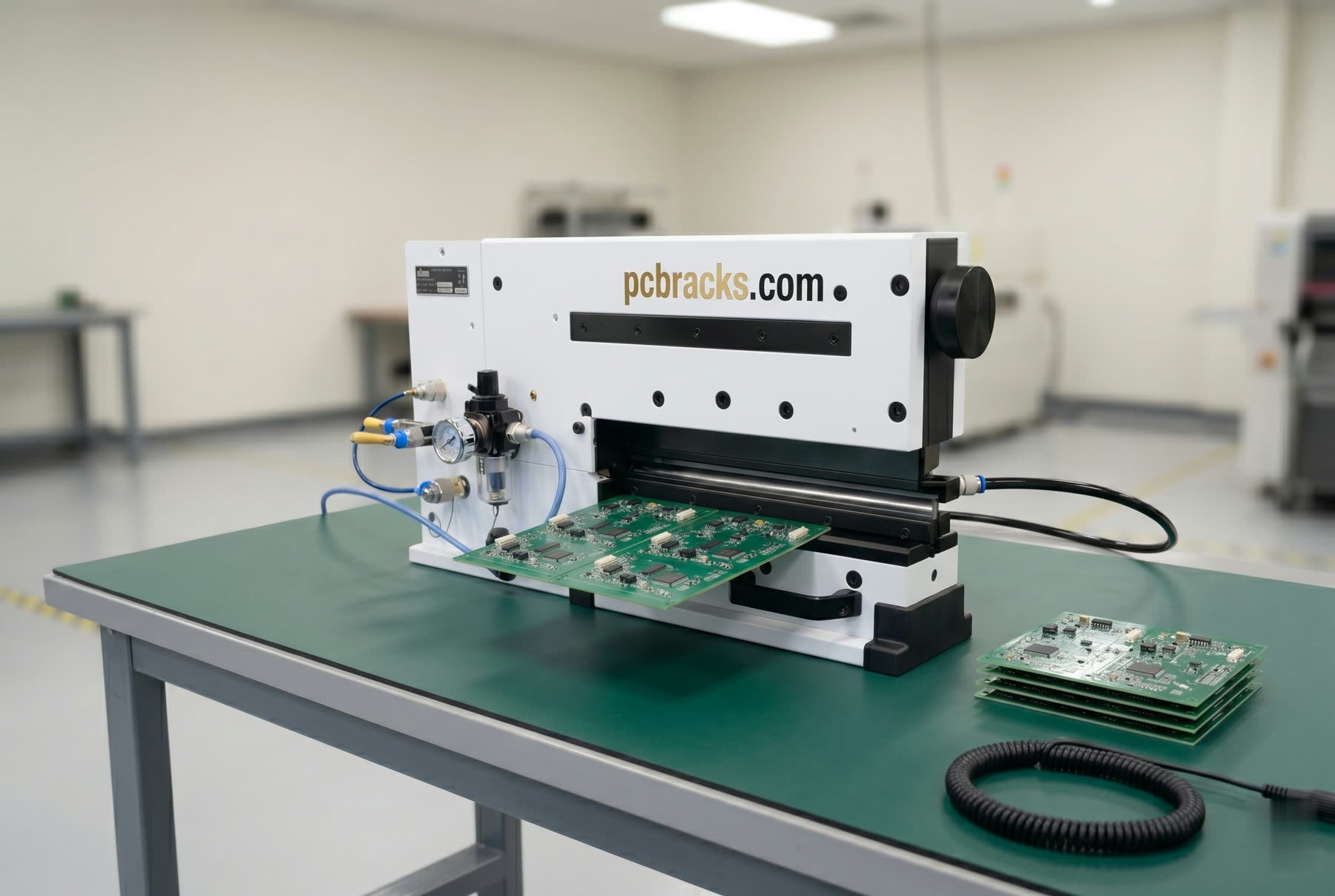
VPD5-330 setup: bench, air and the first cut
Five steps from a crated pneumatic depaneler to a panel separated cleanly. Bonding, the three air fittings, what the panel gauge has to read, the foot switch and the first board through.
Before you touch a knife: close the sliding hand valve and confirm the gauge reads zero. That traps the machine in its fail-safe state, with the upper knife retracted and unable to actuate.
- Bench it and bond it. The unit is 125 kg (275 lb) and arrives with four lifting handles that come off once it is placed. It wants a stable, level bench and an ESD safe surface with a verified ground bus. There is a dedicated bonding terminal on the chassis. Connect it before any assembled board goes near the cutting zone.
- Bring the air in.
Three fittings on the panel. P is the supply. A and B are independent flow controls: B governs the downward speed of the upper knife, A the upward return. Both leave the factory fully open, and reducing flow slows the stroke without changing supply pressure.

Supply into P, foot switch tubing fitted, valves A and B left fully open until the machine is cutting the way you want it to. - Read the gauge, not the compressor.
Open the sliding hand valve. The panel gauge is the operating value: 6 bar (85 psi), from a dry, oil free supply. The published shop supply range is 0.4 to 0.6 MPa (58 to 87 psi). A reading outside that means a supply problem, and the machine should not be used until it is resolved. Far more first-week complaints are a compressor that sagged than a machine that is wrong.

The regulator and gauge sit between the three ports. This gauge, not the one on the wall, is what the machine is actually getting. - Put the foot switch where the operator stands.
It is momentary by design. Release it and the upper knife retracts at once. There is no continuous run mode, so every cut is a deliberate action by the person holding the board.

Foot switch and tubing. Route the line so a chair cannot roll onto it and the operator never has to look down for the pedal. - Take the first cut.
Set the knife gap first if you have not already, then support the panel flat, let the groove carry the score line, press and release. Keep the first separated board as your retained sample. Every shift after this, the first cut of the day gets compared against it, and that one habit catches a drifting gap days before anyone scraps a panel.
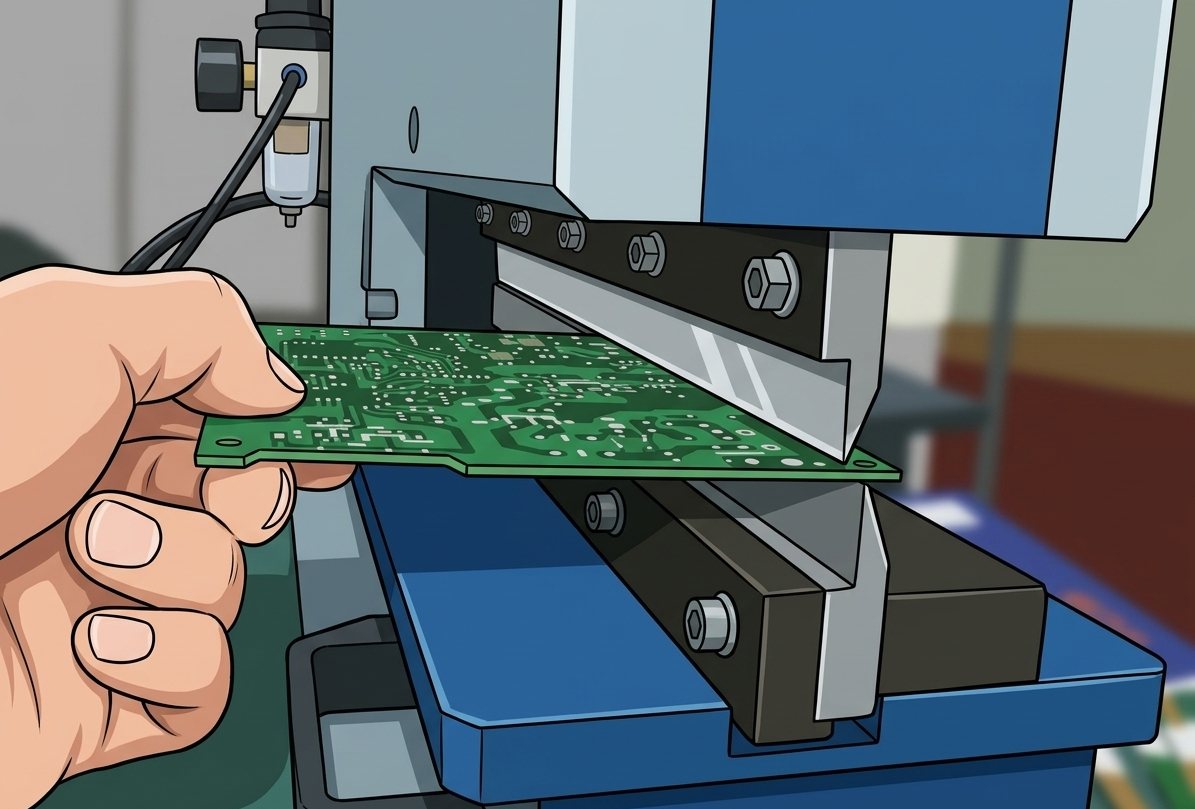
The board rides the groove, flat and supported. A panel held at an angle puts the load into the score line instead of across it, and that is where cracked joints come from.


Next: the knife gap is the one setting that decides whether the cut is clean, and it is set with a 0.05 mm (0.002 in) feeler rather than by eye. That procedure is on blade gap and alignment.
VPD5-330 numbers
| Cut length | 330 mm (12.99 in) |
|---|---|
| Unit weight | 125 kg (275 lb), four removable lifting handles |
| Air | 6 bar (85 psi) at the panel gauge, dry and oil free. Published supply range 0.4 to 0.6 MPa (58 to 87 psi) |
| Power | None. Pneumatic only |
| Knife gap | 0.05 mm (0.002 in) feeler, smooth along the full cut |
| Lubrication | One pump of green or white lithium grease at the lube ports every 2 months on one shift |
| Knives | VPD5-330LK matched pair, changed together |
Machine on order, or still deciding?
The VPD5-330 ships from the US with the knives fitted, the foot switch, the lifting handles and the operation manual. Tell us the panel size and the score depth you run and we will confirm it fits before you raise the PO.
¿Medidas listas? El buscador convierte su tarjeta en un número de parte exacto.