
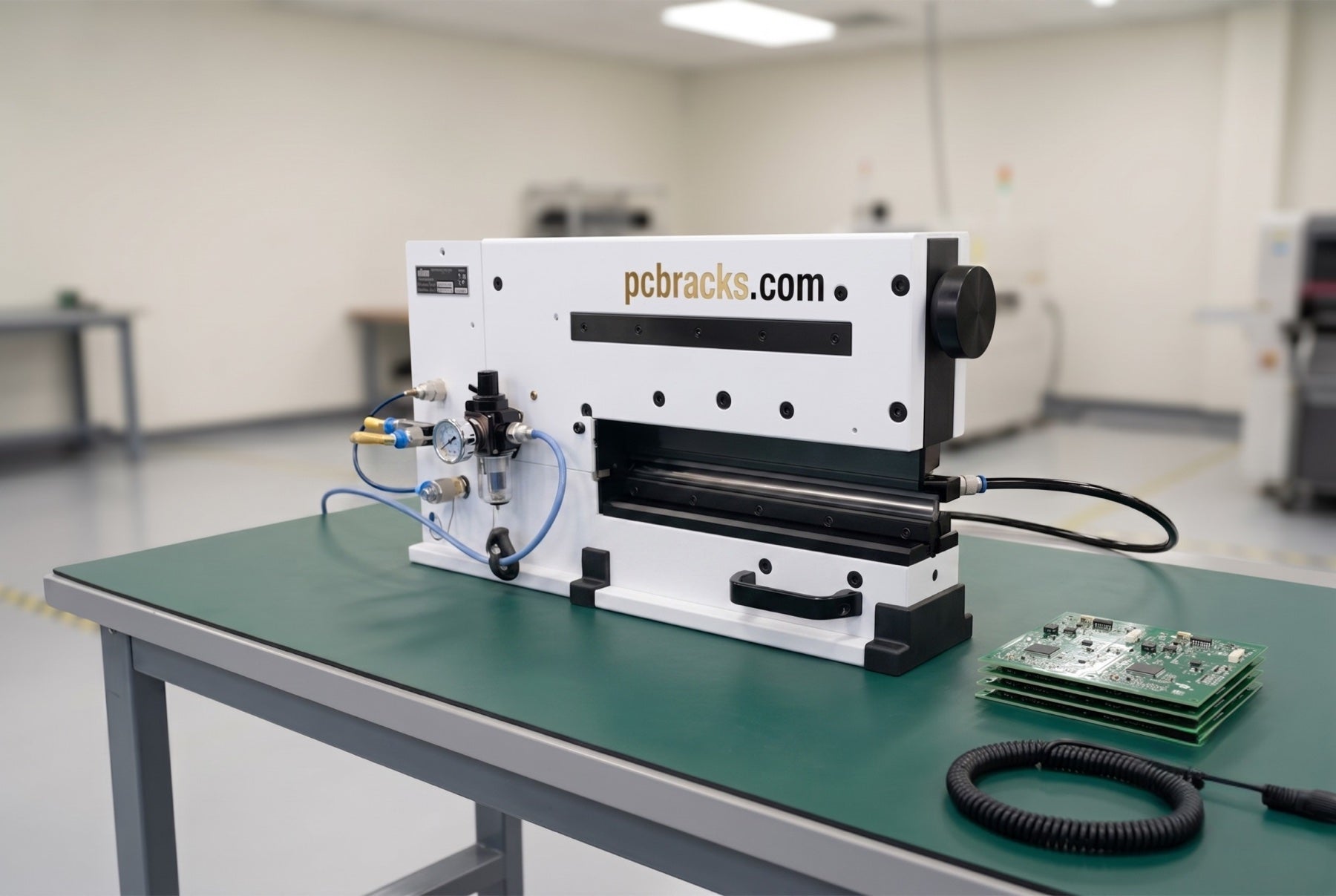
Published by PCBRacks engineering · Last verified: August 2026
Depaneling blade life, and how to spot a dull blade before it costs you boards
What 100,000 cycles means, why the typical number is lower, the four symptoms that appear before scrap does, and what a cut actually costs.
A depaneling blade does not fail. It degrades, quietly, and the first thing that tells you is not the blade. It is the boards.
What does "up to 100,000 cycles" actually mean?
Our blades are rated up to 100,000 cutting cycles. That is the upper figure under favourable conditions: standard FR-4, a well-formed V-score, correct blade alignment and a panel thickness inside the machine's range.
In normal production, 50,000 or more is the number to plan around. We publish both because a single big number is a marketing figure, and a maintenance schedule built on a marketing figure produces scrapped boards.
Four things pull real life below the maximum:
- Board material. High-Tg and filled laminates are more abrasive than standard FR-4.
- Score quality. A shallow or inconsistent V-score makes the blade do work it was not meant to do.
- Thickness at the top of the range. Thicker panels load the edge harder every cut.
- Alignment. A blade running slightly off the groove wears on its flank instead of its edge.
What are the symptoms of a worn V-cut blade?
- Force goes up. On a manual machine the operator notices first: the same panel needs a firmer pull than it did last month. That is edge rounding, and it is the earliest signal you get.
- Burr appears on the cut edge. A sharp edge shears cleanly. A rounded one tears, and the edge condition starts drifting toward the IPC-A-610 limits for your class.
- Fibre pull and white edges. Glass fibres pulling out of the laminate at the cut line mean the blade is dragging rather than shearing.
- Delamination near the score. The last stage, and by then you are scrapping boards. Nothing before this point is expensive. This point is.
Symptoms 1 and 2 are cheap to act on and easy to miss because they arrive gradually. Build a habit of checking the cut edge on the first panel of each shift and comparing it to a retained good sample. Ten seconds, and it catches the drift before Symptom 4.
What does each cut actually cost?
Blade economics are worth doing once, because the intuition is usually wrong.
Take a blade rated to 100,000 cycles. Divide the blade price by the cycles and you are into small fractions of a cent per cut. Even at a conservative 50,000 cycles, the cost per separated board stays trivially small next to the value of the assembly passing through it.
Now price the alternative. One scrapped Class 3 assembly with a cracked ceramic under a BGA is worth more than the blade. A production stop waiting for a blade to arrive is worth more than several.
This is why the answer to "when should I buy a spare blade" is "with the machine". A spare in the drawer is the cheapest insurance in the process, and it converts an unplanned stop into a five-minute change.
How do you change a V-cut blade?
Blades on our machines are user-replaceable at the bench. No factory service call, no return shipment.
Two practices worth keeping:
- Change both blades of a pair together. On a shear, the circular and the linear blade work against each other. A new blade running against a worn one wears fast and cuts unevenly.
- Log the change. Date and approximate cycle count. Two changes in and you know your real blade life on your material, which is a better number than any figure on a datasheet, including ours. Put the next change in the calendar the day you fit a blade, and have the spare on the shelf before that date, not after the line stops.
Which blades fit the VPD3-1M and VPD5-330?
- VPD3-1M: the VPD3-1CB circular blade and the VPD3-1LB stationary linear blade work as a pair. The blade pair kit buys both together for less than buying them separately, which is also the right way to change them. Older purchase records list the same two blades as VPD3-1CK and VPD3C-1LK; the numbers above are the current ones.
- VPD5-330: the VPD5-330LK linear blade set, supplied as a matched pair.
Know your blade change before it stops the line
Tell us your machine, your board material and roughly how many panels you separate a week. We estimate your real blade interval and keep the spare moving on your schedule.
Sizes checked? The finder turns your board into an exact part number.