
Published by PCBRacks engineering · Last verified: August 2026
V-cut, router or manual break: choosing a depaneling method
What each method does to the board, where the strain goes, what it costs per panel, and the cases where a V-cut machine is the wrong answer.
Depaneling is the last operation that can destroy a finished assembly. Everything before it is inspected, tested and documented. Then the panel gets separated, and whatever damage that causes arrives after most of your inspection points.
The method you choose decides how much force reaches the board and where it goes. Here is how the four common methods actually behave.
When is a manual V-break enough?
An operator bends the panel until the V-score fails. No machine, no cost, no cycle time.
It is also the highest-strain method available. The bending moment does not stop at the score line: it radiates several centimetres into the board on both sides. That is where ceramic capacitors crack and BGA solder joints fracture, and neither failure is visible. The board tests fine and fails in the field months later.
It is also the least repeatable method, because the force depends entirely on which operator is at the bench and how tired they are.
Manual break is defensible for Class 1 boards with no ceramics near the break line and no BGAs. For Class 3, hand it to your process engineer alongside IPC/JEDEC-9704 and let the strain numbers make the argument.
When does a pizza-wheel cutter make sense?
A round blade rolls along the score under hand pressure. Better than snapping, because the force follows the groove rather than bending the whole panel.
The limitation is that there is no opposing blade. All the pressure has to be reacted by the board itself, so lateral force transmits into the copper and the laminate next to the score. Edge quality is inconsistent, and burr depends on wheel sharpness and operator speed.
How does a V-cut shear with opposing blades work?
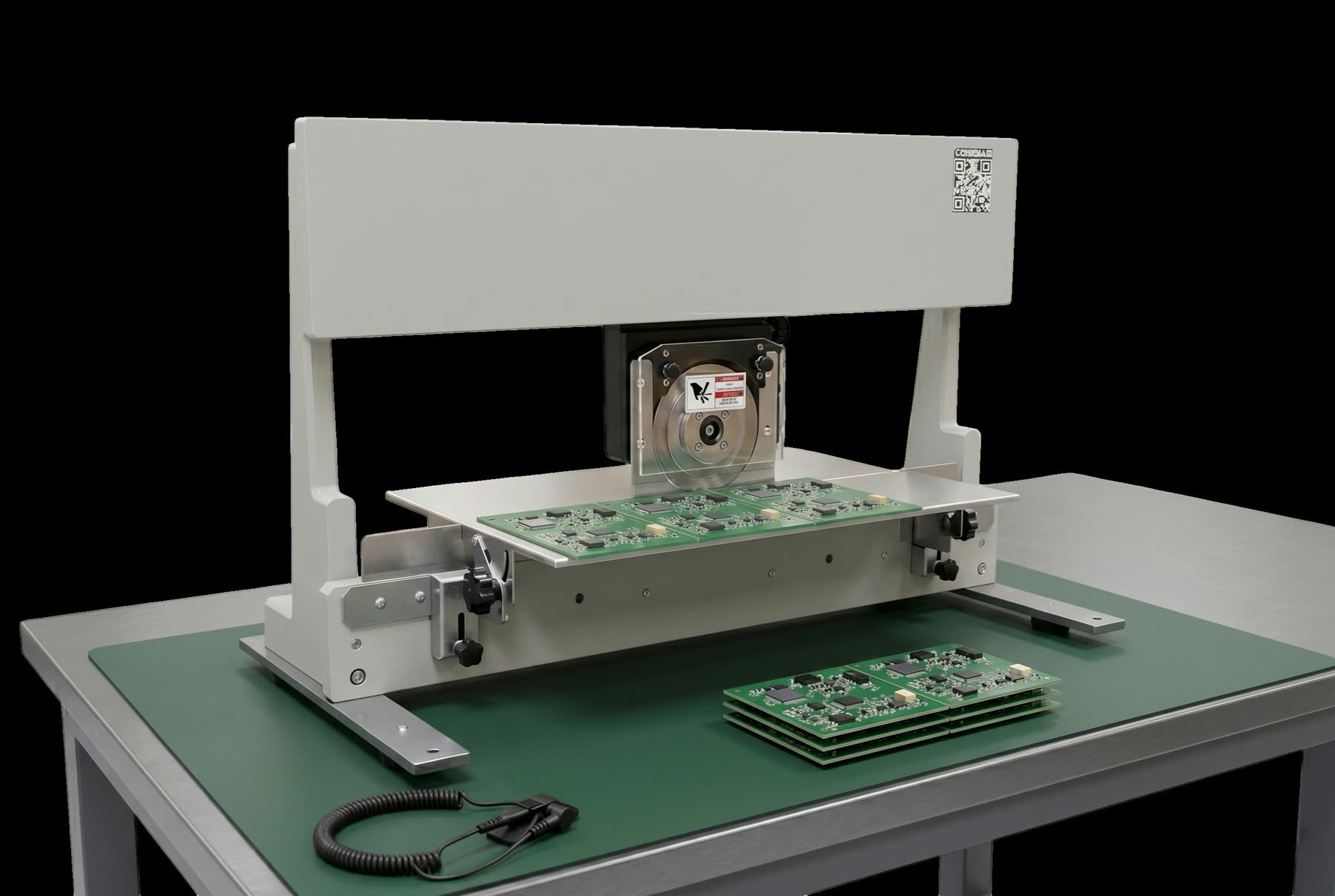
A circular blade rides over a stationary linear blade. The panel passes between them and the cut happens at the moving contact point: a true scissor action.
The reason this matters is where the force ends up. With two opposing blades, the shear is contained inside the V-groove instead of radiating outward. The board on either side of the score is not being bent to break it.
Trade-off: it only works on panels that were V-scored at fabrication. If your panel uses tabs, mouse bites or an irregular outline, a V-cut machine cannot help you.
When do you need a router instead?
A spindle mills the material away along a programmed path. The lowest-strain method available, and the only one that handles non-linear outlines, tabs and mouse bites.
The costs are real: dust extraction, tooling that wears and gets replaced, a program per panel design, longer cycle time per board, and a bigger capital number. For a shop running one or two panel designs in volume, that overhead buys nothing. For a shop running irregular outlines, it is the only correct answer.
How do the depaneling methods compare?
| Method | Board strain | Edge quality | Works on | Cost profile |
|---|---|---|---|---|
| Manual break | Highest, radiates from the score | Inconsistent, operator dependent | V-scored panels | No capital, hidden yield cost |
| Pizza wheel | Moderate, lateral into copper | Variable burr | V-scored panels | Low capital |
| V-cut shear | Low, contained in the groove | Consistent, repeatable | V-scored panels only | Moderate capital, no consumable dust |
| Router | Lowest | Excellent | Any outline, tabs, mouse bites | Highest capital, tooling and dust handling |
Which depaneling method should you choose?
- Is the panel V-scored, or does it use tabs and irregular outlines? Tabs or irregular outlines means a router. There is no shortcut around that.
- What is on the board near the break line? Ceramic capacitors, BGAs and press-fit connectors near the score push you away from manual break regardless of class.
- What IPC class are you building to? Class 3 tightens edge and laminate acceptance criteria and raises the cost of an invisible crack. Class 1 with a bare, simple board can survive a manual break.
Where do the VPD3-1M and VPD5-330 fit?
Both of our depanelers are V-cut shears with opposing blades, for V-scored panels.
- VPD3-1M, manual. Hand-drawn, separates V-scored panels up to 290 mm (11.42″), and needs no compressed air and no electrical supply. It goes where the work is, including a bench with no services.
- VPD5-330, pneumatic. Up to 330 mm (12.99″), driven by shop air at 0.4 to 0.6 MPa, holding board strain under 200 µε in normal operation, which is inside the guidance commonly applied to assemblies with ceramics and BGAs.
If your panels use tabs or irregular outlines, we will tell you a router is the right tool. Selling you a machine that cannot cut your panel helps neither of us.
Send us your panel drawing
Panel size, score geometry, component clearance top and bottom, and throughput. We confirm which machine fits, or tell you if neither does.
Sizes checked? The finder turns your board into an exact part number.