
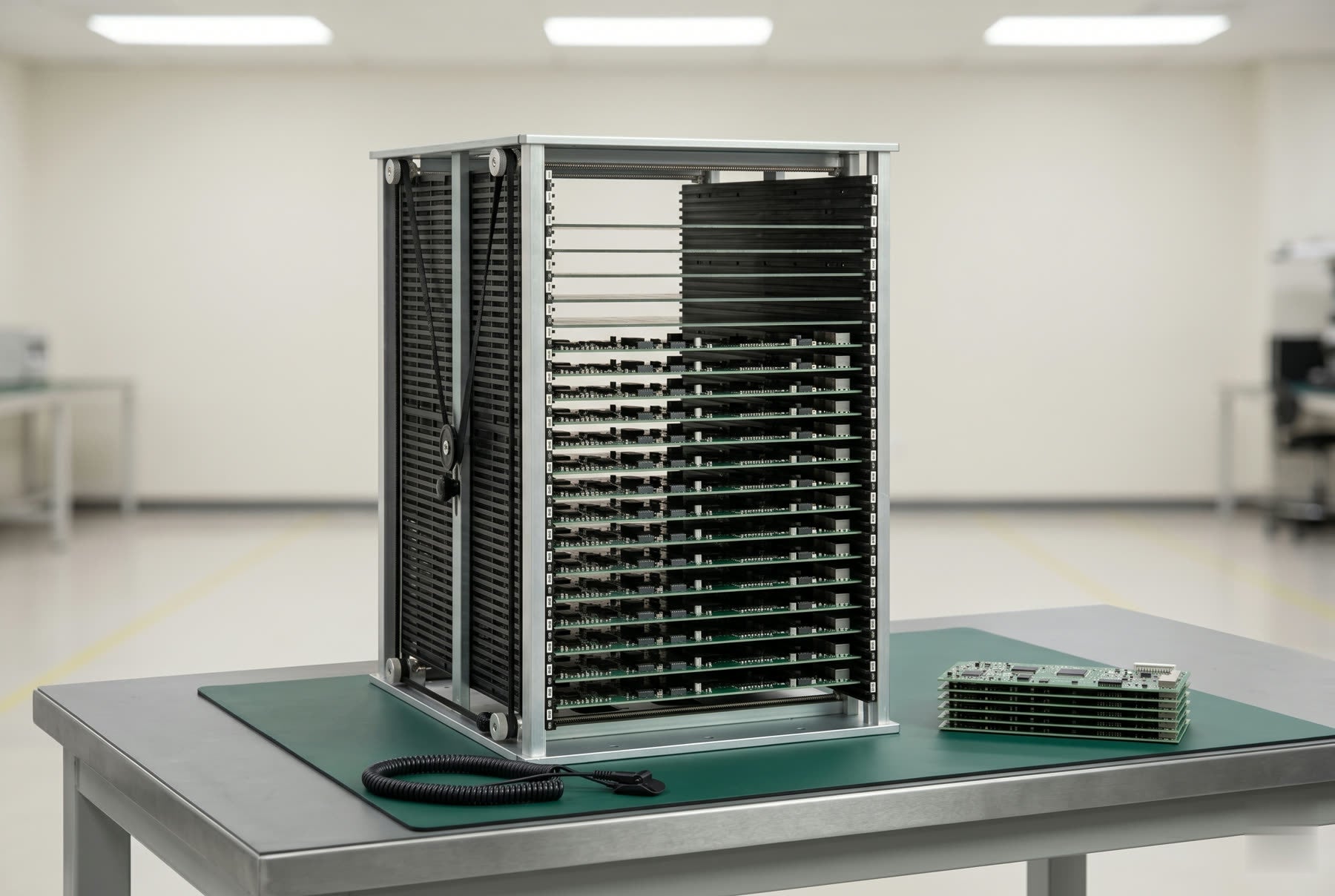
Published by PCBRacks engineering · Last verified: August 2026
Will the rack fit my SMT loader? The interface dimensions that decide it
Chassis height, slot pitch and footprint are what a loader actually cares about, plus the four things to check when your line uses a custom fixture.
An in-line loader does not know what brand your rack is. It knows whether the rack sits in its cradle at the right height, presents boards on the pitch it expects, and lets the pusher reach them. Three numbers cover most of it.
Which three numbers decide loader fit?
| Dimension | Common value | Why the loader cares |
|---|---|---|
| Chassis height | 563 mm (22.17″) | Sets where every slot sits relative to the transfer arm. Wrong height, and the arm meets laminate instead of the slot opening. |
| Slot pitch | 10 mm (0.394″) | The indexing step. The machine advances a fixed distance and expects a board there. |
| Footprint | 355 × 320 mm (13.98″ × 12.60″) | Decides whether the rack seats in the cradle and clears the guides. |
Get those three right and a rack drops into the standard interface used by most in-line loaders and unloaders, including ASM SIPLACE, Yamaha YSM, Panasonic NPM and Juki RS series machines.
When are the standard three numbers not enough?
Lines with custom fixtures, older machines or integrator-built cells can add constraints. Four worth checking before you order:
- Cradle width and guide rails. Some cradles are adjustable, some are set for one footprint. Measure the opening rather than assuming.
- Pusher stroke. The pusher has to reach the board across the full slot depth. A deeper rack than the machine expects means the last portion of the board never gets pushed.
- Sensor position. Optical sensors that detect board presence are aimed at a specific height. A rack that sits low or high can read as empty when it is full.
- Board stop and clearance at the exit. Tall components need clearance leaving the slot, not only sitting in it.
Does the loader interface survive your process temperatures?
A rack that fits the loader when new has to still fit after it has been through your process a few hundred times. If it goes into an oven, thermal cycling must not distort the panels enough to move the pitch.
That is the practical argument for a rack rated well above your process temperature and for a gear track with monitored parallelism: both keep the pitch true, and pitch is what the loader indexes on. A rack that survives the bake but drifts out of pitch has not solved the problem.
Related: baking MSD boards per J-STD-033 covers why the rating needs margin rather than sitting exactly at your bake temperature.
What should you verify before you order?
- Confirm the chassis height your loader expects, commonly 563 mm (22.17″).
- Confirm slot pitch, commonly 10 mm (0.394″), and that your component envelope fits it. If it does not, plan to skip slots rather than change racks.
- Measure the cradle opening and compare to the rack footprint.
- Check pusher stroke against slot depth.
- If your line uses a custom fixture, ask for a fit-check rather than guessing.
Ask for a fit-check
Our 50-slot magazine racks are built to the 563 mm (22.17″) chassis and 10 mm (0.394″) pitch interface, and the same footprint carries across the temperature and adjustment variants, so a rack you add later drops into the same cradle as the one you have.
If your line uses a non-standard fixture, send the loader make and model and the cradle dimensions before you order. We confirm fit in writing. That is a five-minute exchange that prevents a rack you cannot use, and we would rather have the exchange than the return.
Send us your loader model
Make, model and cradle dimensions if you have them. We confirm the interface before you order, in writing.
Sizes checked? The finder turns your board into an exact part number.