
What is a universal PCB tray?
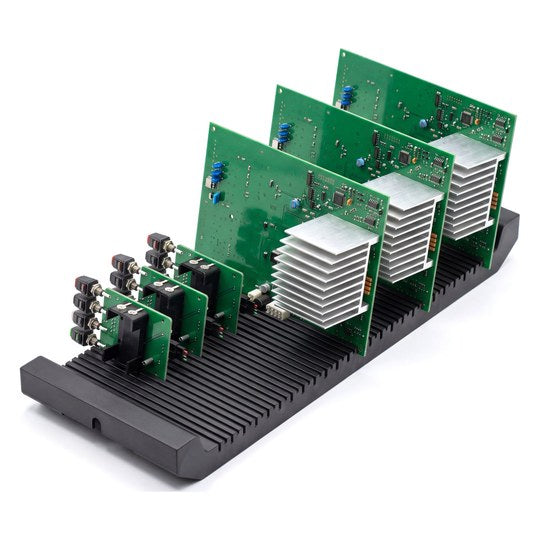
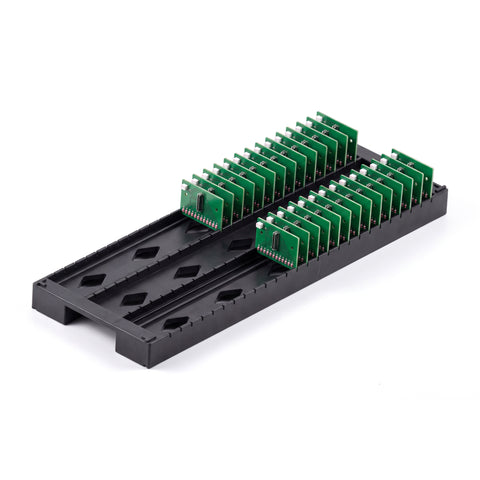
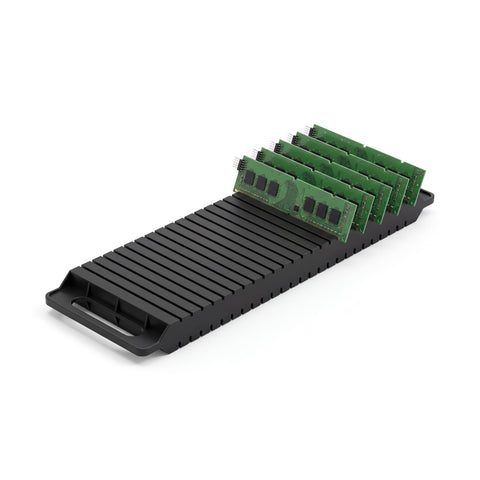
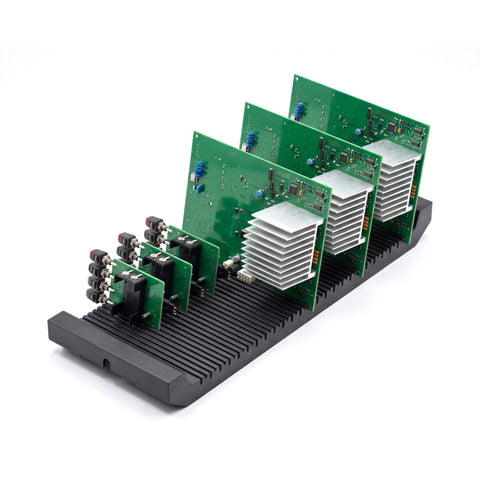
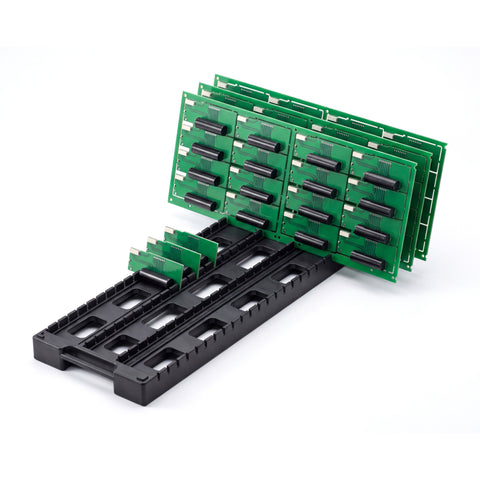
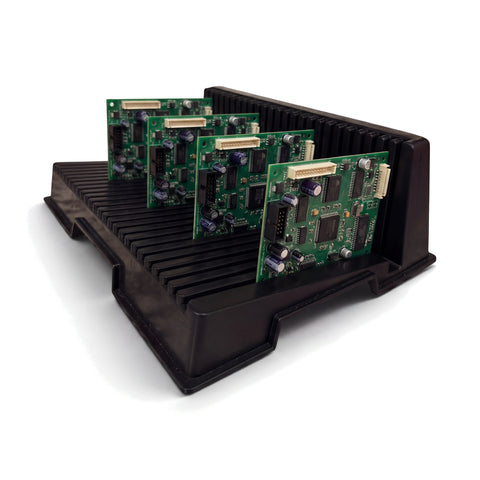
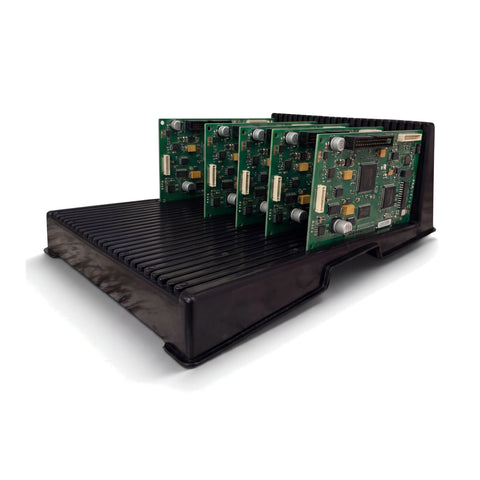
A universal PCB tray is a slotted-edge tray that holds circuit boards upright by their edges, 25 to a tray, at the bench, on a shelf or on a cart. There is no width to set: one tray takes boards of many sizes, which is why it is called universal. It is made for hand work and storage, never for conveyors or SMT loaders.
PCBRacks.com engineering ·

A universal PCB tray is a conductive plastic tray with a row of slots that keep boards on edge and apart from each other. It serves hand soldering, inspection, rework, test and storage between steps. Ours are conductive, 10⁴ Ω, and sold in packs of 10.
What is a universal PCB tray used for?
Universal trays are the bench side of board handling. They are also called slotted-edge PCB racks, universal PCB racks, ESD PCB trays or circuit board trays, and they show up wherever boards are handled by hand.
- Hand soldering and rework. Boards wait upright and apart for the next operation, instead of lying in a stack where parts touch.
- Inspection, QC and test. An inspector works down the row, and passed and failed boards go to separate trays.
- Storage between steps. Full trays go on a shelf or a cart until the next process is ready.
- Next to a depaneler. Panels wait in slotted trays before the cut, and the single boards go into trays after it.
What a tray never does is feed a machine. SMT loaders and unloaders take magazine racks, which have a frame and an adjustable width the machine can step through.
How does a slotted tray hold a board?
Three numbers decide whether a board sits well in a tray.
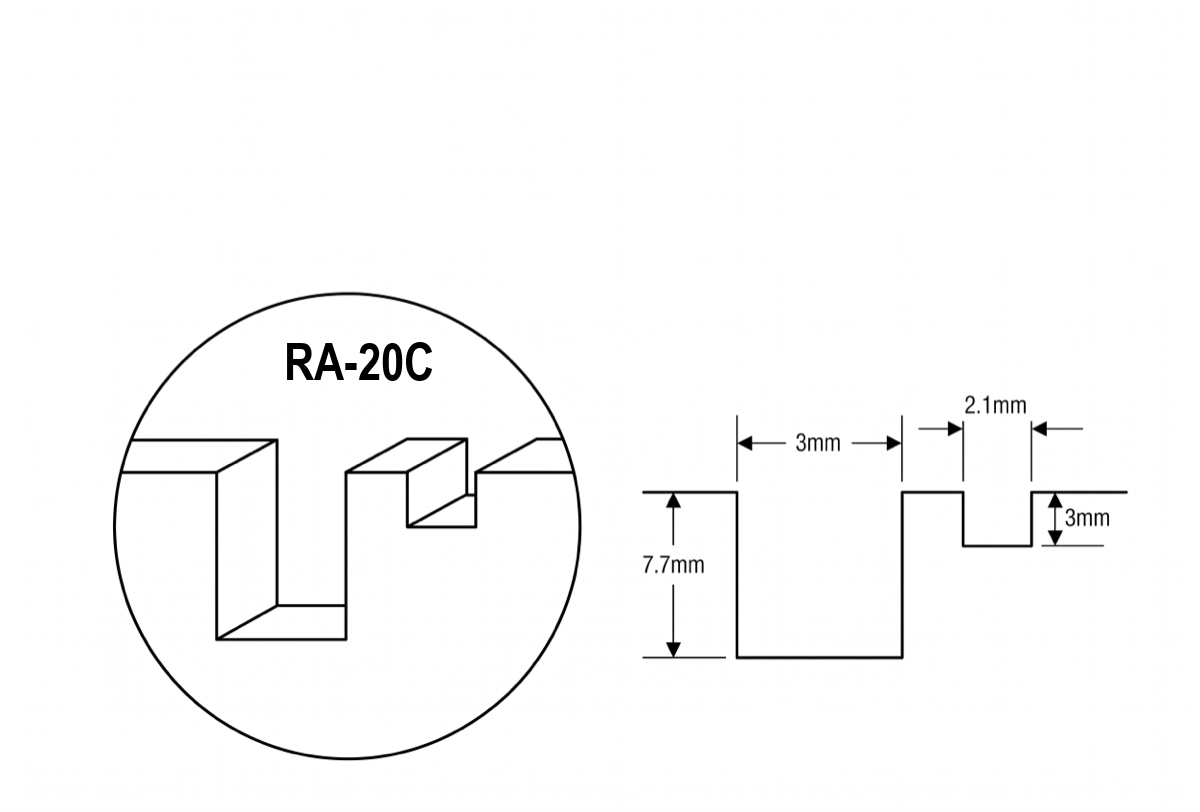
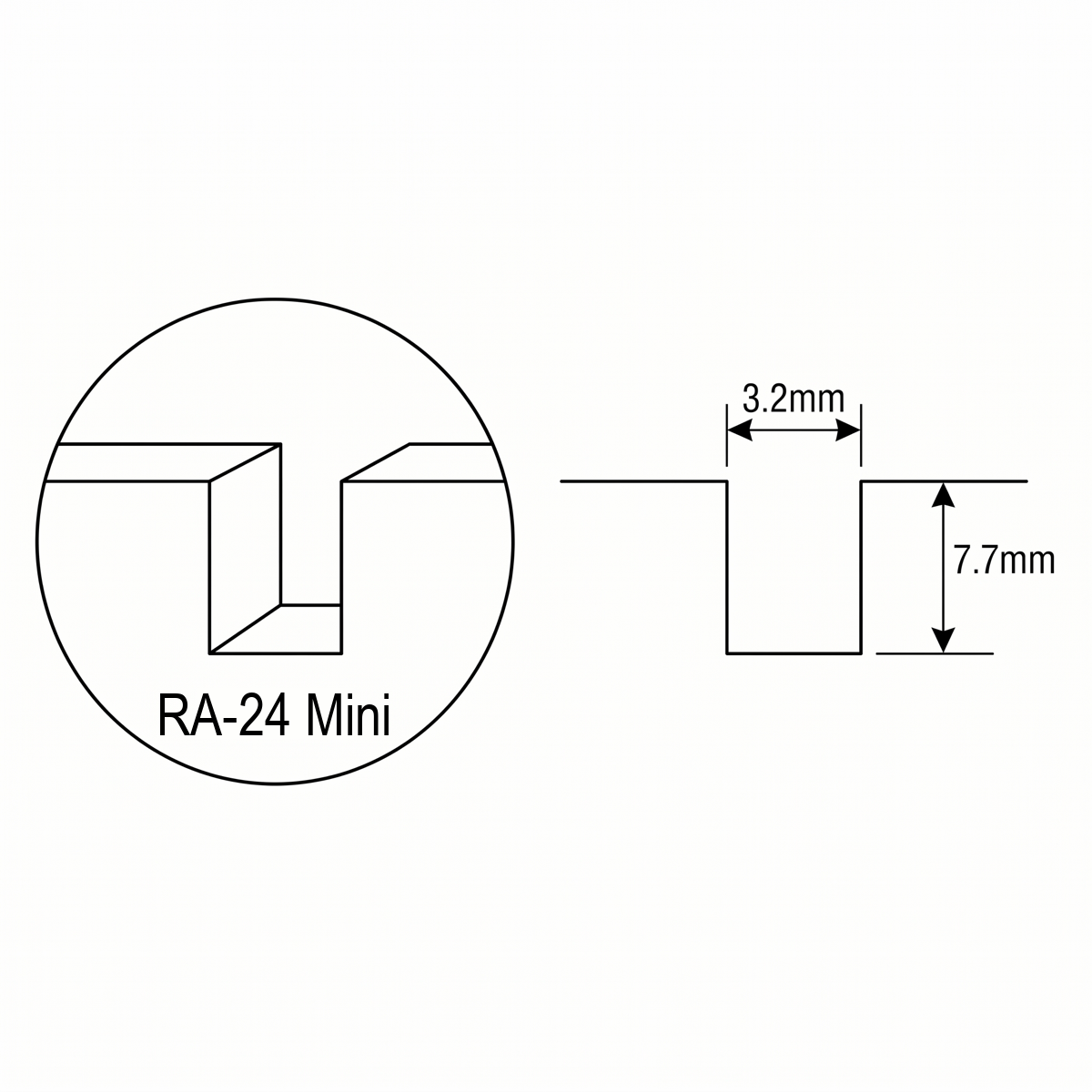
- Slot width. It has to be a little wider than the board is thick. A 1.7 mm (0.067″) slot takes a standard 1.6 mm (0.063″) board; 3 to 3.2 mm (0.118″ to 0.126″) slots take boards up to about 2.4 mm (0.094″).
- Slot depth. How much of the board edge sits in the slot. A deep slot holds better when the tray moves on a cart; a shallow one is quicker to load and unload, and leaves more room for parts near the edge.
- Slot pitch. The distance from one slot to the next, which sets the space between neighboring boards. Trays use 15 to 16 mm (0.591″ to 0.630″) so components on one board stay clear of the next.
What kinds of universal trays are there?
The family splits into flat trays, angled holders and a portable carrier. All hold boards by their edges; the shape decides how the operator reaches them.
| Model | What it is | Largest board | Board thickness, up to | Slots |
|---|---|---|---|---|
| RA-16C | Flat slotted-edge tray for standard boards | 400 × 260 mm (15.75″ × 10.24″) | about 1.6 mm (0.063″) | 25, on 15 mm (0.591″) |
| RA-18C | Tray with carry handles on both ends | 320 × 180 mm (12.60″ × 7.09″) | about 2.4 mm (0.094″) | 25, on 15 mm (0.591″) |
| RA-20C | Two slots at every position, for thin and thick boards in one tray | 400 × 220 mm (15.75″ × 8.66″) | about 2.2 mm (0.087″) | 25, on 15 mm (0.591″) |
| RA-24 Mini | Deep slots for thick, heavy-copper and populated boards | 400 × 220 mm (15.75″ × 8.66″) | about 2.4 mm (0.094″) | 25, on 16 mm (0.630″) |
| PCBH-C | Angled holder for small boards, for tight benches | 152 × 152 mm (5.98″ × 5.98″) | about 2.4 mm (0.094″) | 25, on 10 mm (0.394″) |
| PCBH-2L-C | Double-angle holder, boards presented in an L shape | 305 × 203 mm (12.01″ × 7.99″) | about 2.4 mm (0.094″) | 25, on 10 mm (0.394″) |
| Karry-All 35 | Portable carrier on an aluminum frame, width set by a clamp screw | 350 × 175 mm (13.78″ × 6.89″) | about 3.2 mm (0.126″) | 30, on 10 mm (0.394″) |
Angled holders suit soldering, rework and microscope work, where the operator needs to see the board face. Flat trays suit storage, kitting a job and moving boards between benches on a cart.
Where do ESD turntables fit in?
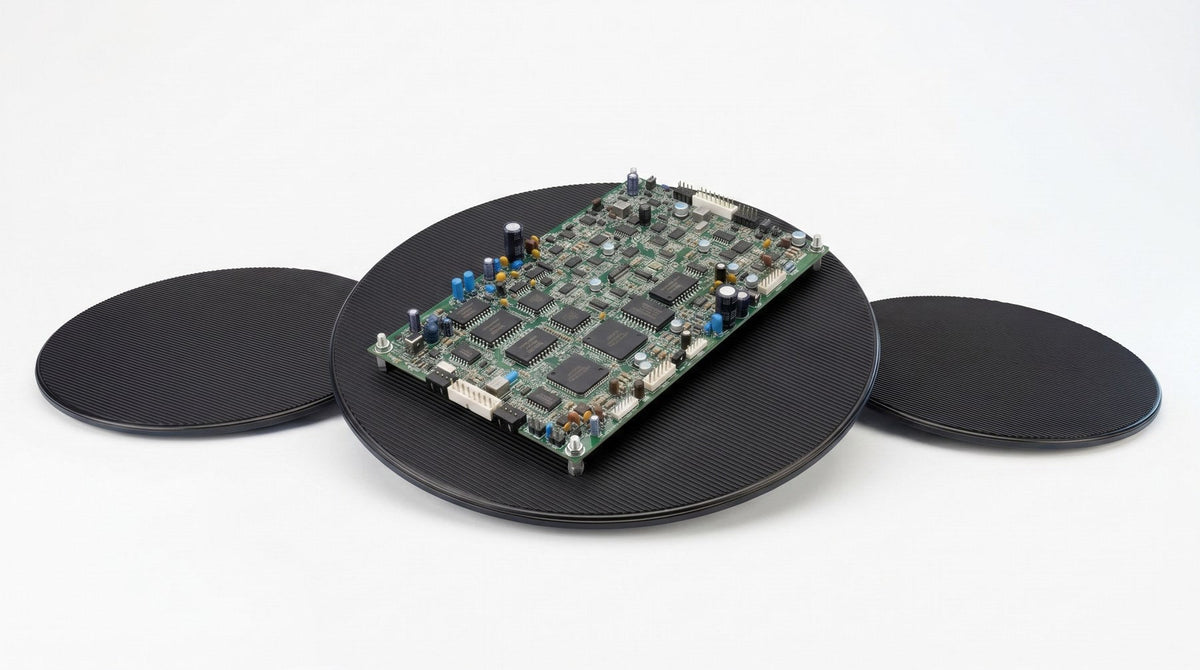
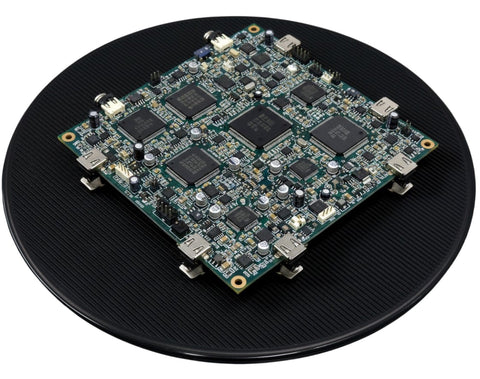
A turntable is the bench's other universal tool. Instead of slots, it is a conductive disc that turns 360° so one assembly can be worked from every side without handling the board itself: rework, mechanical assembly, inspection and QC.
| Model | Disc | Boards up to | Load capacity |
|---|---|---|---|
| D380 | 380 mm (14.96″) | 300 × 250 mm (11.81″ × 9.84″) | 91 kg (200 lb) |
| D500 | 500 mm (19.69″) | 400 × 350 mm (15.75″ × 13.78″) | 113 kg (250 lb) |
Are universal PCB trays ESD safe?
A board picks up and loses charge every time it is handled. The tray's job is to let that charge drain away gently instead of holding it next to the components. Our trays, holders and the Karry-All 35 are conductive polypropylene, 10⁴ Ω, ESD safe and RoHS compliant, with the test reports available to your quality team on request.
The turntables use conductive rubber and carry their own data-sheet values: surface resistance at or below 10⁵ Ω and resistance to ground at or below 10⁷ Ω. ESD surface resistance explained covers what these numbers mean.
Can boards be baked in a universal tray?
No. Conductive polypropylene is rated −10 to 80 °C (14 to 176 °F) and softens above that, so trays and holders stay out of bake and cure ovens. When boards need a moisture bake, move them to a magazine rack rated for it: 200 °C (392 °F) in the GM and M models, or 300 °C (572 °F) in the all-aluminum HT models.
Universal tray or magazine rack?
Ask where the board goes next.
- Into a machine on the SMT line: a magazine rack. It has a frame, adjustable walls and the slot pitch a loader steps on.
- Onto a bench, a shelf or a cart: a universal tray. No width to set, 25 boards per tray, sold in packs of 10.
- Into an oven: a magazine rack rated above the oven temperature.
The magazine rack page has a side-by-side comparison.
What to look for when you buy universal trays
- The board fits the tray length. Check your largest board against the tray's maximum board size.
- The slot is wider than the board is thick. 1.7 mm (0.067″) for standard 1.6 mm (0.063″) boards; 3 mm (0.118″) or more for thick, heavy-copper or populated boards.
- The pitch clears your tallest part. Tall components need the 16 mm (0.630″) pitch of the RA-24 Mini, or a skipped slot.
- The shape suits the job. Flat trays for storage and carts, angled holders for soldering and rework, a turntable for work from every side.
- It is conductive, not just "anti-static". Ask for the resistance rating and test reports your quality team can file.
- You buy enough for the flow. Trays come in packs of 10. Plan one tray for boards waiting and one for boards done at each manual step.
Questions people ask about universal PCB trays
Is a universal PCB tray the same as a PCB holder?
Close. A tray lays boards out flat in a row of slots; a holder stands them at an angle so the operator can see and reach each board. Both hold boards by their edges, both are conductive, and both belong on the bench rather than on the SMT line.
Can a universal tray go on a conveyor or into an SMT loader?
No. Trays have no frame or width setting for a loader to grip and step through. Loaders and unloaders take magazine racks; trays serve the hand-work and storage steps around them.
Can boards be baked in a universal tray?
No. The conductive polypropylene is rated −10 to 80 °C (14 to 176 °F) and softens above that. For a moisture bake or a cure, use a magazine rack rated 200 °C (392 °F) or the all-aluminum 300 °C (572 °F) models.
Will a thick or populated board fit?
Check the slot width against the board thickness. The RA-16C takes standard 1.6 mm (0.063″) boards; the RA-20C takes about 2.2 mm (0.087″); the RA-18C, RA-24 Mini and both holders take about 2.4 mm (0.094″); the Karry-All 35 takes about 3.2 mm (0.126″). For tall parts, the RA-24 Mini spaces its slots 16 mm (0.630″) apart.
Are universal trays ESD safe?
Ours are conductive polypropylene, 10⁴ Ω, and RoHS compliant, with ESD and RoHS test reports for your quality team on request. The turntables carry their own data-sheet values: surface resistance at or below 10⁵ Ω and resistance to ground at or below 10⁷ Ω.
Do universal trays stack?
Yes, empty trays stack, so a pack of 10 takes little shelf space between jobs.
Can I ship boards in universal trays?
No. Trays hold boards at the bench, on the shelf and on a cart between stations. Boards that leave the building go in ESD bags and packaging. The Karry-All 35 is the one carrier in the family, built to take boards between stations and work areas.
Keep reading
Trays, holders and turntables for the bench.
Conductive, ESD safe and RoHS compliant, with test reports on request. Trays, holders and the carrier come in packs of 10. Priced on the page, in stock ships from the USA in under 24 hours, free shipping on US orders of $1,000 and up.

Type a board size or the part number you use today and the finder shows the match.