
What is an SMT magazine rack?
An SMT magazine rack is an adjustable metal-frame rack with two slotted walls that hold printed circuit boards by their edges, one board per slot. A loader feeds the boards from it onto an SMT line, an unloader fills it again at the end, and the same rack keeps boards safe between process steps and in storage.
PCBRacks.com engineering ·

A magazine rack holds 50 boards on edge, 10 mm (0.394″) apart, between two slotted walls set to the board width. SMT loaders and unloaders take it as their standard cassette. Ours are conductive, 10⁴ Ω, and rated for 80, 120, 200 or 300 °C (176, 248, 392 or 572 °F).
What does a magazine rack do on an SMT line?
Surface-mount lines move boards on a conveyor from one machine to the next. Something has to put boards on that conveyor at the start and take them off at the end, and that is the magazine rack's job, together with the machine that holds it.
- At the loader. A full rack goes into the magazine loader at the head of the line. The loader steps the rack down one slot at a time and pushes each board onto the conveyor toward the printer.
- At the unloader. An empty rack waits at the end of the line. The unloader slides each finished board into the next free slot until the rack is full.
- Between steps. A full rack holds the lot between reflow and test, or while a line changes over, so boards wait upright and apart instead of in a pile.
- In storage. The same rack goes on a shelf or a cart. Magazine racks wear several hats: line, buffer and storage.
Benches are different. Hand soldering, inspection and rework stations use universal PCB trays, which hold boards on edge without a frame or a width setting and never go on a conveyor.
How is a magazine rack built?
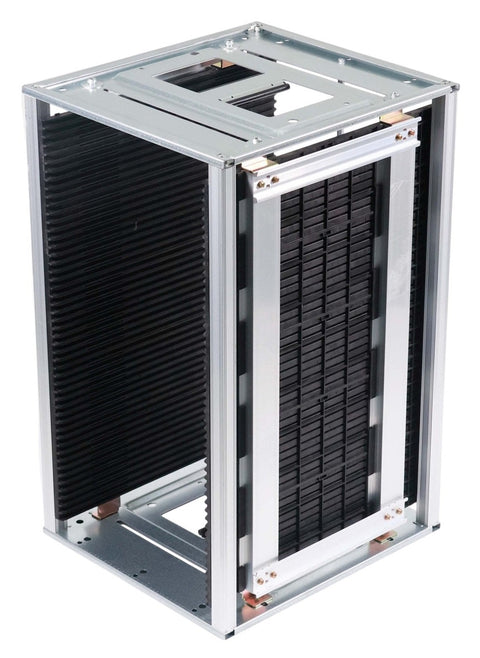
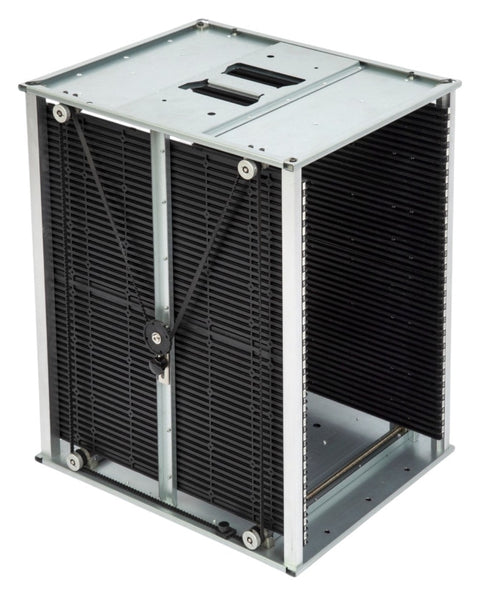
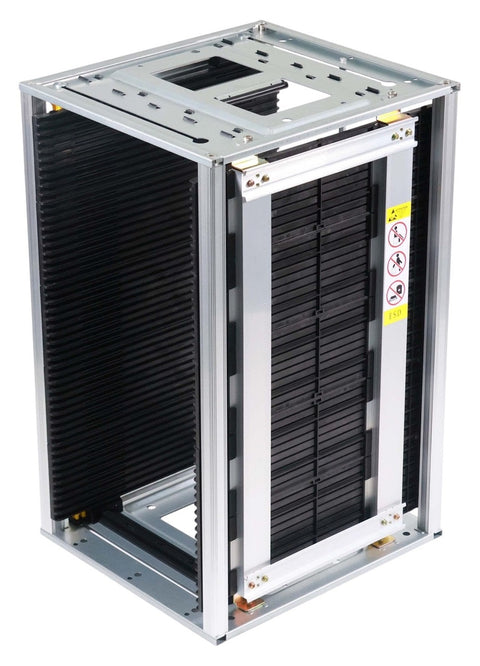
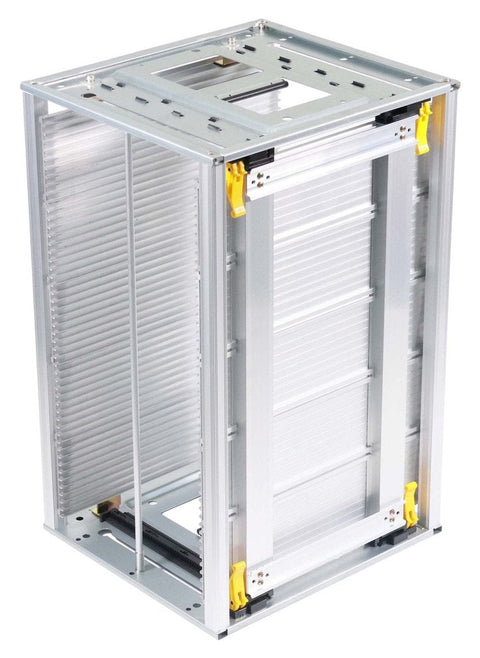
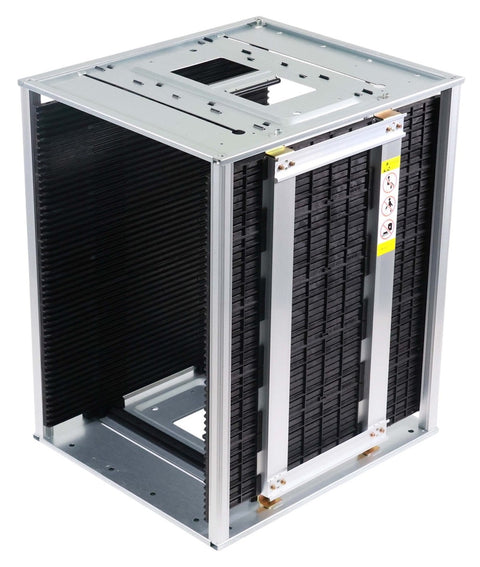
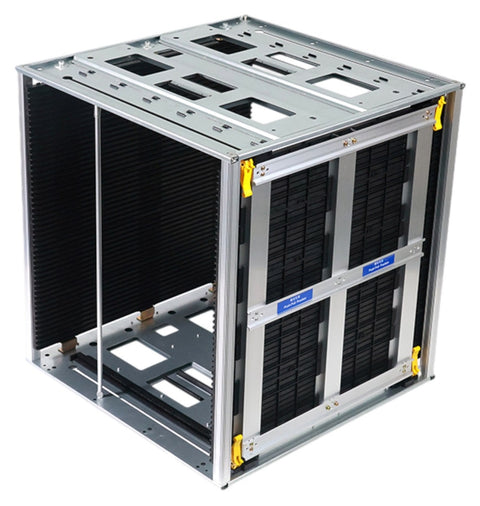
Every magazine rack is a box with one fixed wall and one wall that moves. The board sits across the gap, its two edges in matching slots.
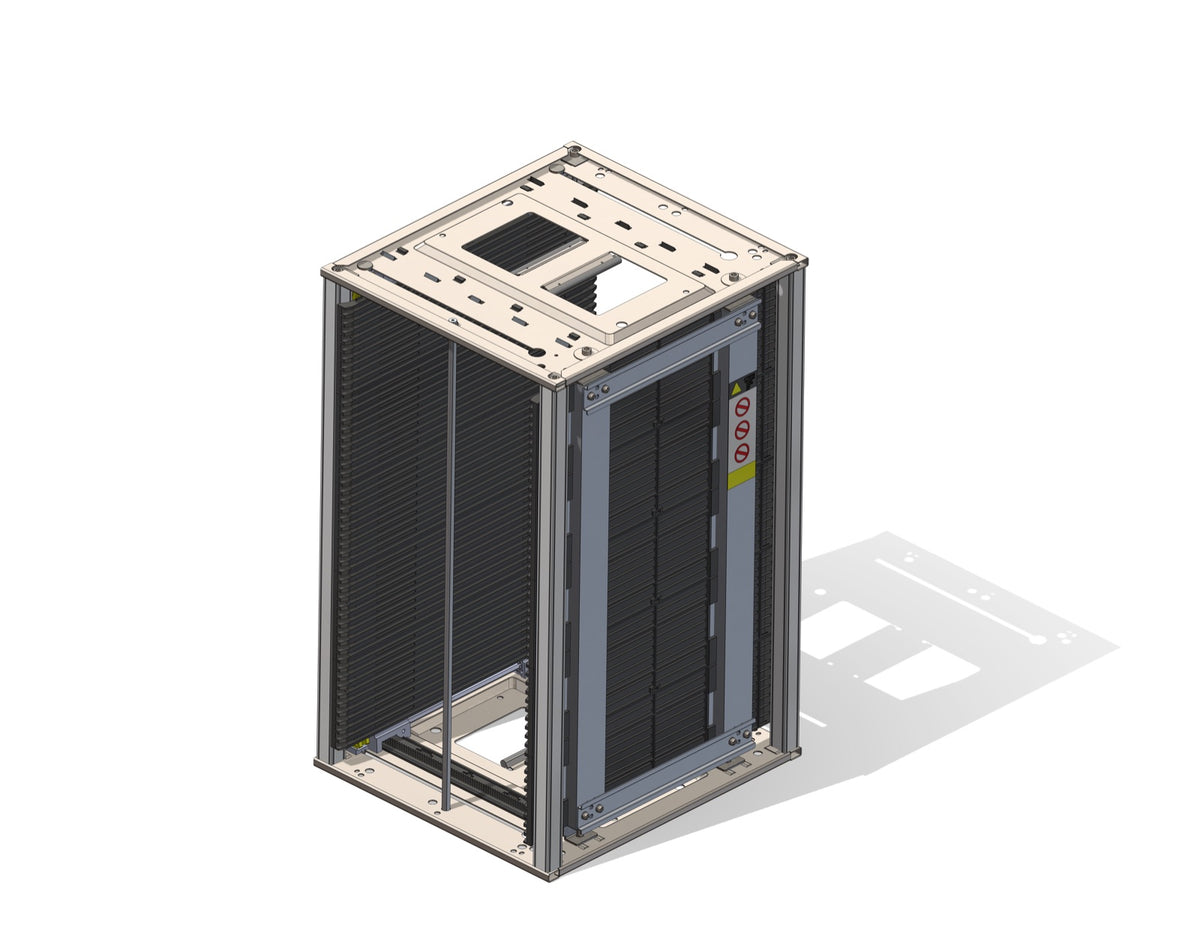
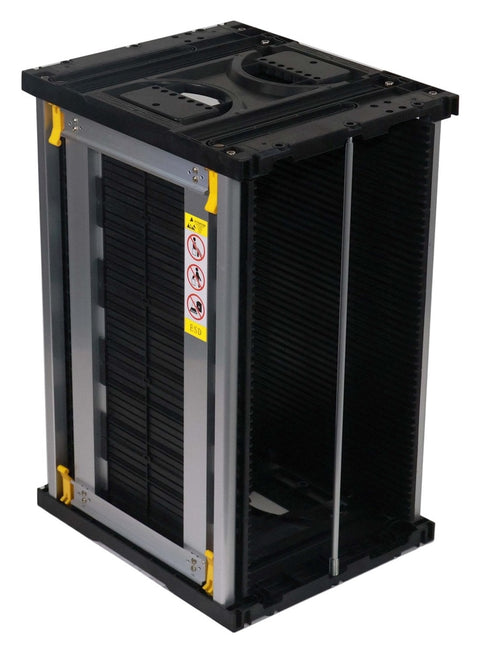
- Base and top plate. Galvanized steel on most models. The B0105 is all-plastic, with a conductive PS base, for lines that want a lighter rack.
- Aluminum pillars. Four corner pillars hold the plates square, so the slots stay level from the top slot to the bottom one.
- Fixed wall and movable wall. Each wall carries slotted side panels that touch the board edges. On most models they are conductive PPE strips you can swap one at a time; on the 300 °C models they are aluminum.
- Adjustment. A gear track, a screw or a belt moves the movable wall to the board width and keeps it parallel to the fixed one.
- Stopper bar and latches. A spring-loaded bar across the top keeps boards from lifting out when the rack is moved, and a yellow latch on each side secures the top plate to the frame.
- Slot numbers. An adhesive strip numbers the slots 1 to 50, for first-in, first-out and traceability.

What sizes do magazine racks come in?
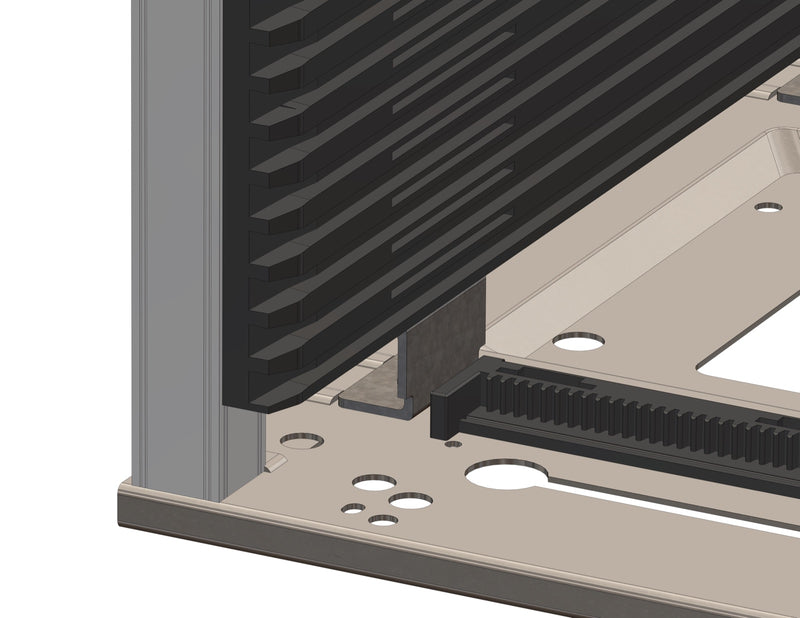
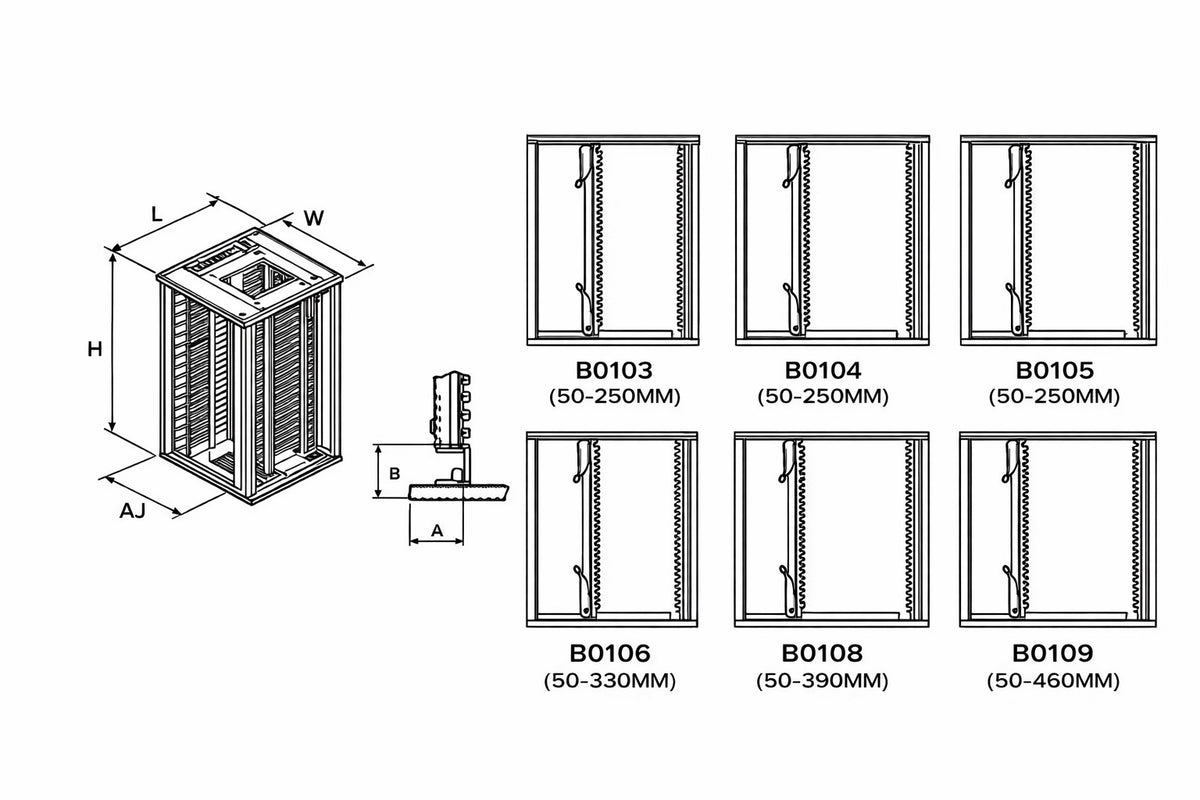
Racks are sized by the board they carry. The board's length runs front to back, and its width sets the distance between the two walls. All of ours have 50 slots on a 10 mm (0.394″) pitch; the chassis grows with the board.
| Chassis | Outside size (L × W × H) | Board length, up to | Board width range |
|---|---|---|---|
| B0103, B0104, B0105 | 355 × 320 × 563 mm (13.98″ × 12.60″ × 22.17″) | 355 mm (13.98″) | 50 to 250 mm (1.97″ to 9.84″); belt model from 10 mm (0.394″) |
| B0106 | 460 × 400 × 563 mm (18.11″ × 15.75″ × 22.17″) | 460 mm (18.11″) | 50 to 330 mm (1.97″ to 12.99″) |
| B0108 | 535 × 460 × 569 mm (21.06″ × 18.11″ × 22.40″) | 535 mm (21.06″) | 50 to 390 mm (1.97″ to 15.35″) |
| B0109 | 535 × 530 × 569 mm (21.06″ × 20.87″ × 22.40″) | 535 mm (21.06″) | 50 to 460 mm (1.97″ to 18.11″) |
| B0110 | 630 × 530 × 563 mm (24.80″ × 20.87″ × 22.17″) | 620 mm (24.41″) | 50 to 460 mm (1.97″ to 18.11″) |
The 355 × 320 mm (13.98″ × 12.60″) footprint with a 563 mm (22.17″) height and 10 mm pitch is the interface most in-line loaders and unloaders are built around. Larger chassis need a loader made for them. The loader interface guide lists the three numbers to check, and the sizing guide walks through fitting a rack to your largest board.
How does the width adjustment work?
The movable wall has to land parallel to the fixed one, or a board jams in the slots. There are three ways to move it, and the right one depends on how often your board width changes.
| Mechanism | How it moves | Best when |
|---|---|---|
| Gear track | A toothed rail with plastic pinions drives both ends of the wall together, in steps. | Widths change often, or you need to return to an exact earlier setting. |
| Screw | Threaded adjusters set the wall position and hold it. | The line runs one board width for months at a time. |
| Belt | A belt moves the wall through a continuous range with no steps. | Widths change daily, or boards are as narrow as 10 mm (0.394″). |
More detail, including what wears over five years of use, is in Gear, screw or belt.
What temperature can a magazine rack take?
The rating tells you whether boards can stay in the rack through a bake or straight out of an oven. Pick a rating above the hottest step the rack will see, because a rack that softens moves its slots, and the loader steps on those slots.
| Rating | Models | Typical use |
|---|---|---|
| 80 °C (176 °F) | GN, N, GPN and GC BELT | The SMT line, storage, moving boards between cells, soldering, inspection and cleaning at normal factory temperatures. |
| 120 °C (248 °F) | B0105GPM | Low-temperature moisture bakes on the light all-plastic chassis. |
| 200 °C (392 °F) | GM and M | Moisture bakes of 90 to 125 °C (194 to 257 °F) per IPC/JEDEC J-STD-033, without moving boards to another rack. |
| 300 °C (572 °F) | GL HT, all-aluminum | Loading next to lead-free reflow, conformal-coat post-cure and aerospace cure cycles. No polymer panels to soften. |
All ratings start at −20 °C (−4 °F), so cold storage is not a problem.
What makes a magazine rack ESD safe?
An electrostatic discharge can damage a component without leaving a mark, and the board then fails later in the field. A rack is ESD safe when the surfaces that touch the board let a charge drain away instead of holding it.
On our magazine racks the side panels that touch the board are conductive, 10⁴ Ω, on a metal frame. Every rack is ESD safe and RoHS compliant, and the ESD and RoHS test reports go to your quality team on request. What the resistance numbers mean, and how they are measured, is in ESD surface resistance explained.
How many boards does a rack hold, and do racks stack?
A rack holds one board per slot, so 50 boards. Boards with tall parts can skip every other slot, which leaves 20 mm (0.787″) between boards and fits 25 per rack.
Magazine racks stack even when they are full. Up to five loaded racks can sit on top of each other, which matters when the line backs up and floor space runs out. The payload is 85 kg (187 lb) per rack spread evenly across the slots, and 50 kg (110 lb) on the all-plastic B0105.
Magazine rack or universal PCB tray?
Both hold boards on edge, and both are conductive. Where the board is going decides which one you need.
| Magazine rack | Universal PCB tray | |
|---|---|---|
| Where it works | SMT loaders and unloaders, buffers between steps, storage | Benches, shelves and carts: hand soldering, inspection, rework, test, storage |
| Width setting | Adjustable walls: gear, screw or belt | None; one tray takes many board sizes |
| Feeds an SMT loader | Yes | No |
| Slots | 50, on 10 mm (0.394″) | 25 or 30, on 10 to 16 mm (0.394″ to 0.630″) |
| Temperature | 80 to 300 °C (176 to 572 °F) | Up to 80 °C (176 °F) |
| Sold as | One rack | Packs of 10 |
The trays have their own explainer: What is a universal PCB tray?
What to look for when you buy a magazine rack
- Your largest board fits. Measure the longest and widest board you build, and pick the chassis that takes both with room to spare.
- Your loader takes it. Check the chassis height, the slot pitch and the footprint your loader expects. If you are unsure, send the loader make and model and we confirm the fit before you order.
- The adjustment suits your changeovers. Gear for frequent changes and exact repeats, screw for one width held for months, belt for narrow boards and daily changes.
- The rating is above your hottest step. 80 °C (176 °F) for the line and storage; 120, 200 or 300 °C (248, 392 or 572 °F) if boards stay in the rack through a bake or a cure.
- The board-contact surfaces are conductive. Ask for the resistance rating and for test reports your quality team can file.
- Parts can be replaced. Side panels, gear tracks and latches wear. A rack whose parts are sold separately stays in service for years.
For the full selection walk-through, read How to choose an ESD PCB magazine rack.
Questions people ask about magazine racks
Is a magazine rack the same as a PCB rack?
"Magazine rack" is the name for the adjustable, metal-frame rack that SMT loaders and unloaders take. "PCB rack" is the wider term and also covers slotted-edge trays, holders and carriers used at the bench. Every magazine rack is a PCB rack, but a slotted tray does not fit a loader.
Why is it called a magazine?
For the same reason as the magazine in a stapler: it holds a stack of identical items that a machine feeds one at a time. The loader steps the rack one slot at a time and pushes each board onto the conveyor.
Can boards of different widths share one rack?
Not at the same time. Both side walls hold the board edges, so one rack runs at one width setting. Boards of the same width and different lengths can share a rack as long as each fits the chassis length.
Can a magazine rack go into an oven?
Only if its rating is above the oven temperature: 120 °C (248 °F) for the B0105GPM, 200 °C (392 °F) for the GM and M models, 300 °C (572 °F) for the all-aluminum HT models. The 80 °C (176 °F) models stay on the line and in storage.
What does slot pitch mean?
The distance from one slot to the next. It is 10 mm (0.394″) on every magazine rack we sell, and the loader steps the rack on that distance, so it has to match what the loader expects.
Are magazine racks used to ship boards?
No. Magazine racks hold boards in production and storage, and move between stations on a cart. Boards that leave the building travel in ESD bags and packaging, not in racks.
Can worn parts be replaced?
Yes. Side panel strips, gear tracks, pinions, latches and stopper bars are sold one part at a time, so a rack with a worn part goes back on the line instead of being replaced.
Keep reading
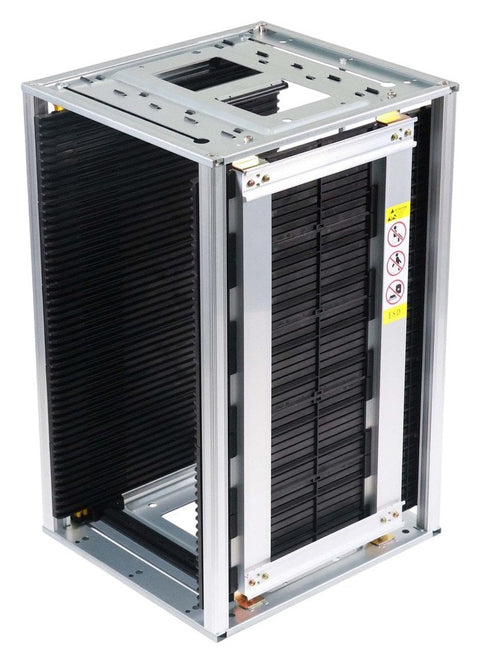
Magazine racks for every board size and process.
Every rack has 50 slots on 10 mm (0.394″), conductive 10⁴ Ω board-contact panels and RoHS-compliant materials. Priced on the page, in stock ships from the USA in under 24 hours, free shipping on US orders of $1,000 and up.
Type a board size or the part number you use today and the finder shows the match.